Copper peptides have a plausible place in wound-healing research. That does not make a diabetic foot ulcer a stand-in for aging facial skin. The scientific question is narrower: did a particular topical preparation improve a defined wound outcome when added to organized clinical care? Answering that question requires separating wound-area reduction from the number of people healed, and a treatment-specific result from a general ingredient claim.
The central ulcer paper was published in 1994, not 2006 as its later PubMed indexing can suggest. This analysis uses its indexed primary abstract and author-posted full-text optical character recognition, or OCR. Original table and figure layouts were not verified. The companion laser and cell studies are available here as indexed primary abstracts. Together, these reports support an evidence hierarchy—not a shortcut from laboratory activity to a finished cosmetic cream.
The ulcer trial enrolled 181 people; that total is not the denominator for its immediate-treatment plantar-ulcer comparison.
Study facts at a glance
Whole-study population: The ulcer trial enrolled 181 people; that total is not the denominator for its immediate-treatment plantar-ulcer comparison. Source 5
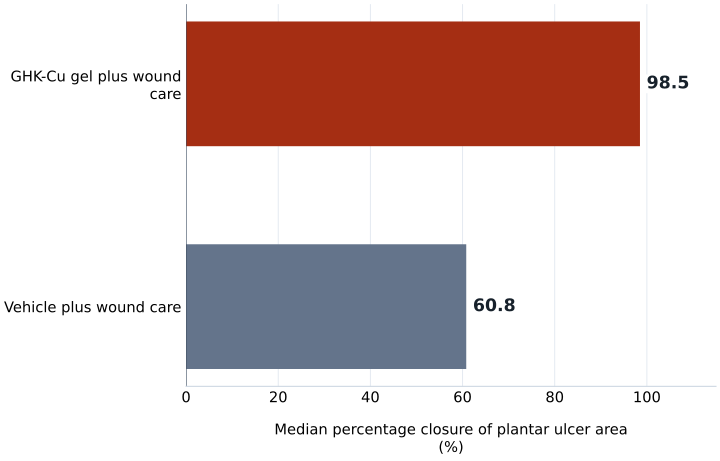
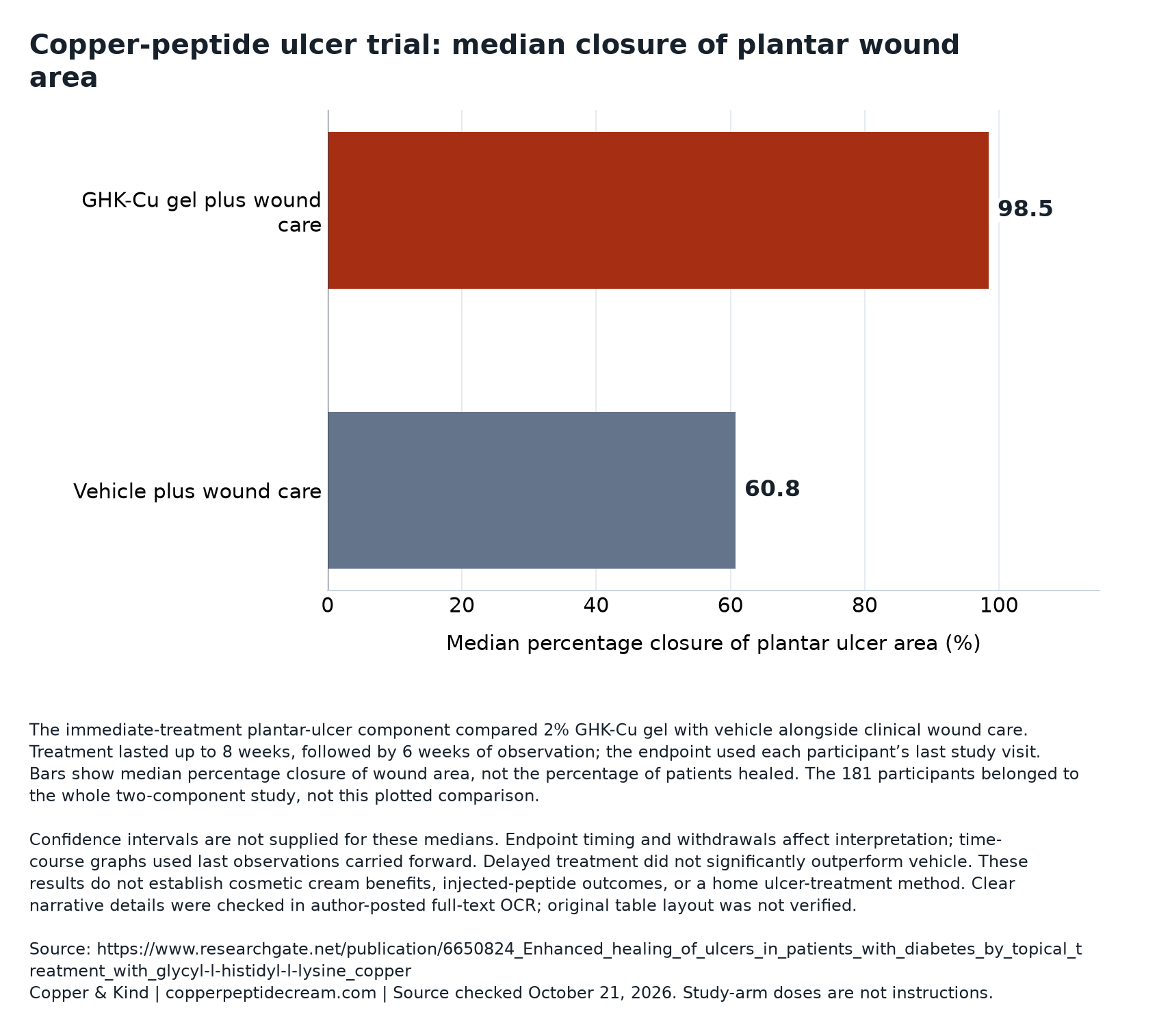
Main numerical signal: Median wound-area closure was 98.5% with active gel versus 60.8% with vehicle in the immediate-treatment plantar component. Source 2 Source 5
What the percentage measures: Area closure is a change in wound size, not the percentage of participants whose wounds completely healed. Source 2 Source 5
Safety boundary: The reported infection comparison—7% versus 34%—concerned plantar ulcers treated immediately after debridement, not the whole trial. Source 2
Cosmetic boundary: Neither an ulcer trial nor experiments in cultured cells establish wrinkle improvement from a retail copper-peptide cream. Source 2 Source 3 Source 4
The experiment tested an addition to care
The multicenter trial was randomized, evaluator-blinded, and vehicle-controlled. Everyone received standardized care incorporating debridement, pressure-relieving footwear, and education. The investigational topical GHK-Cu gel was therefore tested as an addition to care, not against leaving ulcers untreated.
This comparator makes the clinical question more demanding and more useful. A vehicle is the formulation without the active ingredient; it helps distinguish the ingredient's added contribution from the surrounding treatment package. Randomization supports causal comparison, while blinded evaluation helps limit expectations influencing measurements. Neither feature makes different wound types interchangeable.
Interpretation: the treatment effect belongs to a package with shared clinical support. Removing that support changes the question. It would be scientifically inappropriate to treat the result as evidence that any copper-containing topical product, used under unrelated circumstances, reproduces the trial. Our guide to what copper peptide cream means explains why an ingredient name is only the beginning of product identification.
Read the underlying chart data: download CSV or download the source-labeled chart.
One trial contained different treatment clocks
Immediate treatment compared 2% gel with vehicle for up to eight weeks, followed by six weeks of observation. A delayed component used four weeks of vehicle before eight additional weeks of vehicle, 2%, or 4% gel. These are historical topical study arms, not application instructions.
The schedules answer different questions. Starting an intervention at entry asks about adding treatment during the initial clinical response. Introducing it later asks about adding treatment after that response has already begun. Even with the same ingredient, those are not equivalent biological or statistical comparisons.
A percentage on a gel label also does not fully specify exposure. Formulation, delivery to tissue, and treatment context matter alongside concentration. The cream-versus-serum guide addresses that distinction for cosmetics. Interpretation: a higher percentage cannot repair an evidence mismatch between an ulcer preparation and a facial product; matching a number is not matching an experiment.
How to keep the trial's treatment schedules separate
| Component | Reported schedule | Question addressed |
|---|---|---|
| Immediate | Up to 8 weeks of 2% gel or vehicle, then 6 weeks of observation | Addition at initial treatment |
| Delayed | 4 weeks of vehicle, then 8 weeks of vehicle, 2%, or 4% gel | Addition after a lead-in period |
A whole-study total does not describe every comparison
Participants averaged 60 years of age. Eligibility required adequately controlled diabetes and a full-thickness below-knee ulcer; exclusions included bone infection and gangrene. These selection rules define the population before any outcome is calculated.
A trial's total enrollment describes recruitment, not the precision of every analysis within it. Once investigators separate participants by wound location, treatment timing, and starting size, each comparison uses only part of the original population. Attaching the largest enrollment number to a restricted result makes that result appear more extensively supported than it is.
Illustrative reasoning: imagine a study spanning several locations and two treatment schedules. A result confined to one location and one schedule cannot be assigned the enrollment of all locations and schedules combined. The same principle applies here. Because the OCR tables are ambiguous, this article does not publish arm-specific denominators or categorical healing proportions. That restraint preserves a usable result without manufacturing precision from damaged formatting.
Area closure is not a patient healing rate
The headline median comparison favored active treatment, with a reported P value below .05. The difference between the two medians is 37.7 percentage points. This is a difference in wound-area closure summaries—not a 37.7-point increase in the chance that an individual patient completely healed.
Illustrative calculation: area closure can be expressed as 100 × (starting area − remaining area) ÷ starting area. A hypothetical wound shrinking from 200 to 20 square millimeters has 90% area closure, yet remains open. A separate count of fully healed wounds would answer a different question. Likewise, crossing a near-complete-closure threshold is not identical to achieving complete closure.
A median describes the middle observation after outcomes are ordered. It does not reveal the entire distribution: two groups can have similar medians but different numbers of very poor outcomes, or different medians with substantial overlap. The headline result is informative, but it cannot reconstruct individual outcomes or show how consistently benefit occurred. That distinction also matters when evaluating before-and-after evidence.
Three measurements that answer different healing questions
| Measurement | What it describes | What it does not establish |
|---|---|---|
| Median percentage area closure | Middle value of proportional wound-area reduction | Percentage of patients completely healed |
| Categorical near-complete closure | Number crossing a specified closure threshold | Complete closure in every responder |
| Normalized closure rate | Calculated movement of the wound edge over time | A corresponding multiple of patients healed |
Enlarging wounds explain negative closure values
For study-defined larger plantar ulcers around the 100-square-millimeter threshold, the indexed abstract reports median closure of 89.2% versus −10.3%, with P below .01. The body OCR instead describes vehicle-area expansion of 10.4%; that unresolved 0.1-point discrepancy should not be silently erased.
A negative closure value is mathematically sensible. In an illustrative example, a wound beginning at 200 square millimeters and expanding to 220 has −10% closure. Nothing about this means a negative proportion of people healed. It means the remaining wound area exceeded its starting area.
The scale also has an important asymmetry. Improvement ends at 100% closure, but deterioration has no equivalent lower limit: a wound can grow beyond twice its starting size. Extreme worsening can therefore pull a mean downward more strongly than complete closure can pull it upward. Medians reduce that influence, but do not make deterioration clinically irrelevant. A subgroup difference also does not, by itself, establish that starting size modifies treatment response; that requires an appropriate comparison of treatment effects.
The endpoint was each participant's last visit
Weekly tracing and planimetry supplied the primary effectiveness measurements. The end-of-study result used the last visit when a participant left; longitudinal graphs carried the last value forward. Persistent infection could trigger withdrawal.
These choices matter because an observation schedule and an outcome time are different things. A trial may allow a long follow-up window without measuring every participant at its end. Consequently, the headline area comparison should not be described as an outcome measured after 14 weeks in everyone.
Carrying the last value forward keeps an earlier observation in later summaries. It does not establish what happened afterward. Illustratively, a participant leaving with an incompletely closed wound might subsequently improve, remain stable, or worsen; the carried-forward value represents none of those possibilities with certainty. Including all participants in an analysis also does not eliminate uncertainty from incomplete follow-up. The scientific question is how sensitive the comparison would be to plausible later outcomes—not merely whether every enrolled person appears somewhere in the analysis.
Closure speed and delayed treatment need separate interpretations
The immediate plantar comparison showed a more-than-threefold mean normalized closure rate, with P below .01. This Gilman measure describes calculated linear wound-edge advance in millimeters per day. Delayed treatment did not show significant improvement over vehicle.
A rate is not a probability. Threefold edge movement does not mean threefold more people healed, nor does it establish that every wound would close in one-third the time. Geometry, changing wound shape, observation duration, and departures from constant healing speed all complicate that translation.
The delayed findings also deserve their own interpretation. A nonsignificant between-group result is not proof that wounds remained unchanged over time, and it is not proof that treatments were equivalent. Timing may matter, but the contrast does not establish a mechanism. Distinguishing an altered wound environment from changing natural healing rates would require a design capable of separating those explanations. The present evidence leaves that question open rather than showing that concentration alone determines response.
The infection signal is narrower than a safety verdict
The abstract reports a significant infection difference, P below .05, in the restricted immediate-treatment plantar comparison. Across treatment groups, overall adverse-event rates were not significantly different. Exact event counts and confidence intervals are not available in the accessible reporting used here.
The infection percentages differ by 27 percentage points. That arithmetic describes the reported group-level contrast; it should not be converted into a whole-trial infection-prevention claim. Nor does an infection difference identify a direct antimicrobial mechanism. A clinical endpoint can improve without the trial revealing the biological pathway responsible.
Safety and efficacy also overlap without becoming interchangeable. Fewer wound infections would be clinically important, yet that endpoint does not summarize every possible adverse effect. Conversely, a nonsignificant overall adverse-event comparison cannot exclude uncommon harms. Confidence intervals would help show the range of effects compatible with the data. A P value indicates incompatibility with a particular null model under its assumptions; it does not supply the missing precision or prove broad safety.
Cell experiments supply hypotheses, not cosmetic outcomes
One fibroblast-culture abstract reports increased collagen synthesis without a change in cell number. Another reports increased MMP-2 expression alongside secretion of TIMP-1 and TIMP-2, which regulate matrix-remodeling enzymes. Copper ions reproduced the MMP-2 effect; GHK alone did not.
These findings describe interacting processes, not simply collagen accumulation. Tissue structure depends on production, breakdown, organization, and regulation. An increase in a laboratory marker therefore cannot be read as a proportional increase in firmness, a reduction in wrinkles, or a clinically beneficial change in a person.
Interpretation: translation requires several additional bridges. A finished formulation must deliver an active substance to relevant tissue, produce an appropriate response in living skin, and improve a meaningful outcome without unacceptable adverse effects. Culture experiments do not establish those bridges or identify a cosmetic application concentration. The percentage-label guide explains why laboratory concentration and bottle percentage are not interchangeable. These experiments also provide no basis for inferring systemic injection benefits.
The laser comparison involved a different injured-skin setting
A separate randomized post-CO2-laser study had 13 completers. Its abstract reports no significant between-group objective advantage in redness resolution, wrinkles, or overall skin quality, while a patient-reported outcome favored GHK-Cu at P = .04. Concentrations, adverse-event counts, effect sizes, and confidence intervals were not reported in that abstract.
Objective and subjective findings need not agree: they measure different aspects of experience. Improvement after a procedure in both groups also cannot be attributed to the added ingredient. The small comparison does not establish equivalence or prove no effect. Our laser-resurfacing study analysis examines those distinctions.
Interpretation: neither injured-skin setting validates routine intact-skin cosmetics, compounded alternatives, or other routes. ProCyte's product and corporate involvement are identifiable in the ulcer report, but the accessible text does not establish a formal funding declaration. Commercial involvement warrants transparent scrutiny, not automatic dismissal. For service comparisons, the Likeness Rx review and SuperHealthy Rx review invite checking documentary terms only; they imply no connection to this trial or its outcomes.
Questions about the evidence
Does near-total median area closure mean nearly everyone healed?
No. A median wound-area result and a patient healing proportion use different units. One summarizes how much wounds shrank; the other counts people meeting a defined endpoint. Even a wound with very little area remaining may still be open. The trial's categorical near-complete-closure analysis is separate and should not be substituted for complete healing.
Why not calculate a number needed to treat from the infection percentages?
That would imply more certainty than this accessible record supports. A useful number needed to treat needs a clearly defined population, endpoint, time horizon, and trustworthy event denominators. Here, the result is subgroup-specific and original table layouts remain unverified. Describing the reported contrast is more defensible than presenting a seemingly precise treatment yield.
Does the delayed-treatment finding show copper peptides stopped working?
No. It shows that those comparisons did not demonstrate an added benefit under that schedule. Statistical nonsignificance does not establish biological inactivity, unchanged wounds, or equivalence. The important unresolved issue is whether timing changes the treatment effect, rather than whether one can assign a universal working-or-not-working label to the ingredient.
Could a face cream be substituted for the study gel?
The evidence does not support that substitution. Matching an ingredient name does not match formulation, tissue exposure, manufacturing characteristics, or clinical supervision. This article describes historical research, not home ulcer-care instructions. A diabetic wound requires clinical assessment; a cosmetic product should not be treated as a trial-validated wound therapy.
What would stronger evidence for a cosmetic cream look like?
Interpretation: a direct trial would test the finished product in its intended users against a suitable comparator, with prespecified appearance outcomes, adequate follow-up, documented withdrawals, and adverse-event reporting. Objective measurements and patient assessments could both be useful, provided they remain distinct. Laboratory plausibility would help explain the hypothesis, not replace the clinical result.
What this evidence supports
The ulcer trial supports a bounded signal for a specific topical preparation added to standardized care, particularly in its immediate-treatment plantar comparison. Its strongest lesson for cosmetic readers is methodological: identify the population, comparator, measurement, and observation time before interpreting a large percentage. The evidence is neither meaningless nor a general endorsement of copper-peptide products. It leaves unresolved the precision and reproducibility of the clinical effect, the explanation for timing differences, and the relevance to intact facial skin. Those questions require direct evidence rather than increasingly broad interpretations of the same historical result.
Research access and limitations
The ulcer analysis uses the indexed abstract and author-posted full-text OCR, not verified original table or figure layouts. Ambiguous arm counts and categorical proportions are omitted. The laser and laboratory analyses use indexed primary abstracts only. Confidence intervals and several reporting details remain unavailable; no current prescribing or regulatory status is inferred from these historical reports.
Sources & further reading
Commercial sources establish what a seller publishes. They do not independently verify its results. Browse the source library.
- Effects of topical copper tripeptide complex on CO2 laser-resurfaced skin (2006)Published randomized study · checked 2026-10-21. Abstract retrieved through Europe PMC / MEDLINE. Thirteen completers; post-laser setting. Objective between-group improvements were not significant; patient satisfaction favored GHK-Cu. Not a study of the products reviewed here.
- Enhanced healing of ulcers in patients with diabetes by topical treatment with glycyl-l-histidyl-l-lysine copper.Primary research · checked 2026-10-21. Indexed primary study abstract
- Stimulation of collagen synthesis in fibroblast cultures by the tripeptide-copper complex glycyl-L-histidyl-L-lysine-Cu2+.Primary research · checked 2026-10-21. Indexed primary laboratory-study abstract
- The tripeptide-copper complex glycyl-L-histidyl-L-lysine-Cu2+ stimulates matrix metalloproteinase-2 expression by fibroblast cultures.Primary research · checked 2026-10-21. Indexed primary laboratory-study abstract
- Mulder et al., 1994: GHK-Cu in diabetic neuropathic ulcers (author-posted full text)Primary research · checked 2026-10-21. Author-posted primary full-text OCR; original table and figure layout not verified