Copper peptides occupy an unusual space in skin care: an ingredient can have interesting biological activity without having demonstrated the benefit advertised for a particular cream. The most useful question is therefore not simply whether copper peptides do something. It is whether a tested formulation improved a defined outcome, compared with an appropriate alternative, in people whose skin resembles the intended user’s skin.
A study of topical copper tripeptide after carbon dioxide laser resurfacing offers a particularly instructive example. Its patient questionnaire and objective assessments pointed in different directions. Understanding that difference requires separating experience from appearance, improvement over time from added treatment benefit, and injured skin from an intact face. Laboratory experiments and a diabetic-ulcer trial provide context, but they answer different questions rather than supplying missing cosmetic proof.
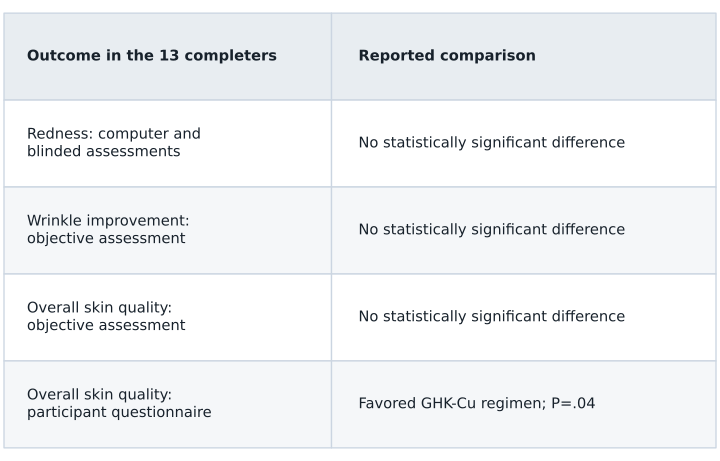
Thirteen patients completed a randomized comparison of post-resurfacing regimens with or without topical GHK-Cu.
Study facts at a glance
Laser study population: Thirteen patients completed a randomized comparison of post-resurfacing regimens with or without topical GHK-Cu. Source 1
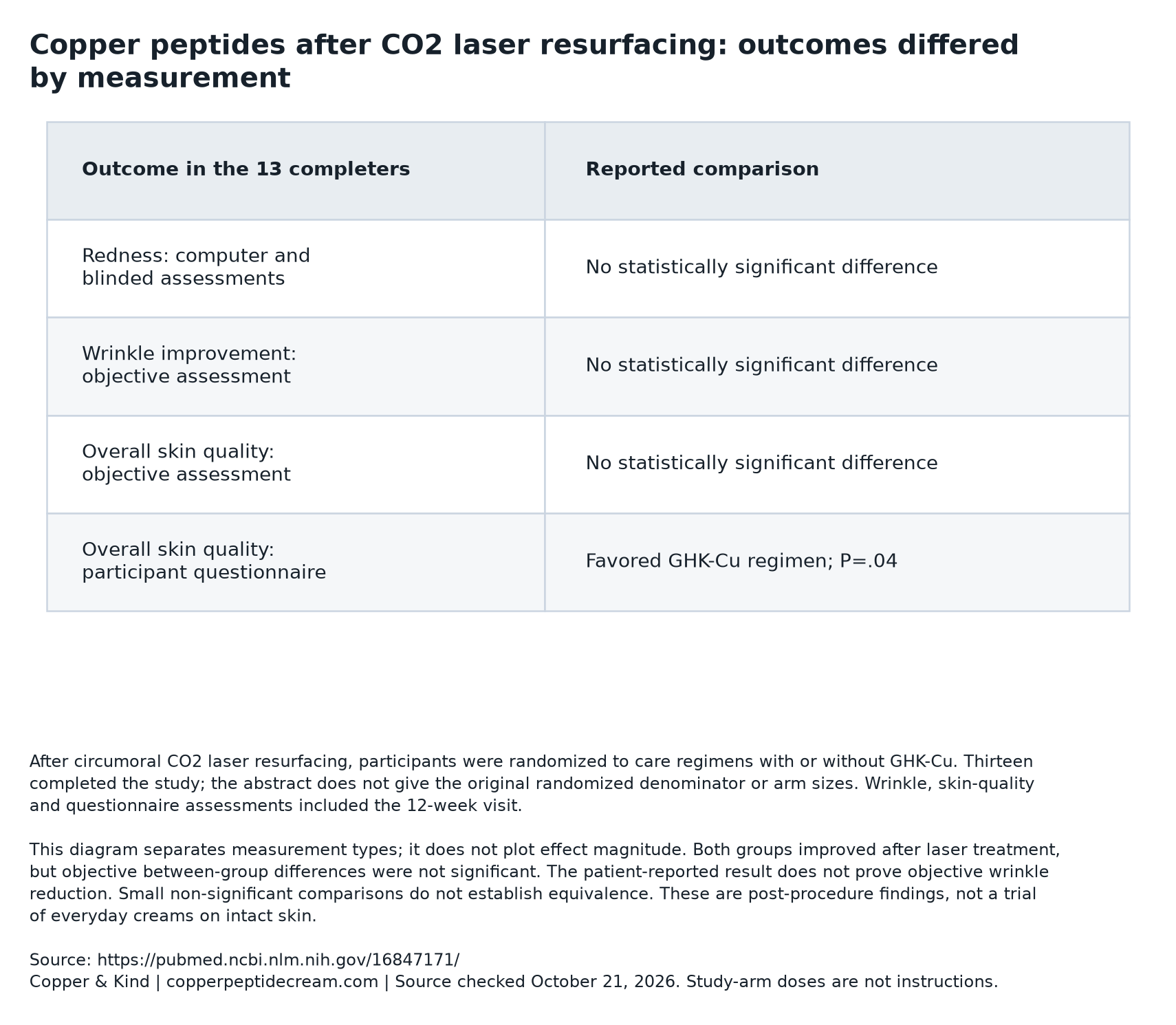
Objective findings: The laser study reported no statistically significant between-group advantage for redness, wrinkles, or overall skin quality. Source 1
Patient-reported finding: A questionnaire favored the GHK-Cu regimen, with P = .04; the abstract supplies no effect size or confidence interval. Source 1
Different clinical setting: The ulcer trial enrolled 181 people across the whole study, not 181 in the immediate-treatment plantar-ulcer comparison. Source 5
Mechanistic evidence: Fibroblast experiments address collagen production and matrix remodeling, not the clinical effectiveness of a finished facial cream. Source 3 Source 4
What the laser comparison actually tested
The 2006 report studied skin around the mouth after CO2 resurfacing, with assessments extending to 12 weeks. Redness was evaluated using computer analysis and blinded evaluators. Wrinkle and appearance assessments were accompanied by a validated patient questionnaire. This analysis uses the indexed primary report abstract, not an examined full protocol or supplement. Initial enrollment, arm sizes, attrition, concentration, adverse-event counts, and funding are not supplied there.
The central design question is incremental benefit: what did adding the copper-containing regimen contribute beyond the procedure and comparison care? Randomization helps make that comparison credible, while blinded assessment limits the opportunity for an evaluator’s expectations to influence a rating. Neither feature makes the study large or its measurements automatically sensitive. For readers distinguishing an ingredient from a treatment claim, the copper peptide cream guide provides the relevant vocabulary: naming an ingredient is not the same as identifying a clinically tested finished product.
Read the underlying chart data: download CSV or download the source-labeled chart.
Improvement after treatment is not proof of an added benefit
Both laser-study groups improved in wrinkles and overall skin quality. That observation answers a different question from whether the copper regimen was better. In a procedure study, before-and-after improvement combines everything occurring between those observations. The treatment contrast is the difference between the groups’ changes, not the change within the copper group alone.
Illustrative reasoning makes the distinction concrete. Suppose two hypothetical groups improve by similar amounts after the same procedure. Showing only the copper group’s starting and ending photographs could create a persuasive story while hiding the equally favorable comparator. That hypothetical improvement would not establish an ingredient effect, however dramatic the photographs looked. This is why before-and-after evidence needs a comparison framework, consistent assessments, and a clear account of accompanying care. The relevant scientific claim concerns the extra improvement attributable to the tested regimen.
Three questions that should not be treated as interchangeable
| Question | Relevant comparison | Interpretive limit |
|---|---|---|
| Did skin improve after resurfacing? | Follow-up versus baseline | Does not isolate the contribution of the copper regimen. |
| Did the copper regimen add measurable benefit? | Copper versus comparison regimen | Requires between-group estimates and their uncertainty. |
| Did patients perceive a better result? | Patient-reported ratings between groups | Addresses experience, not necessarily measured wrinkle or redness change. |
A nonsignificant result does not establish equivalence
The objective comparisons did not cross the study’s statistical significance threshold. This means the available analysis did not demonstrate a difference; it does not mean that both regimens were proven equivalent. Equivalence requires a different framework: investigators specify how much difference would count as practically unimportant and test whether the uncertainty fits inside that boundary.
In a small completed sample, the range of plausible effects can remain broad. Without confidence intervals, readers cannot see whether the results exclude a worthwhile advantage or remain compatible with one. The missing initial enrollment also prevents a clear assessment of completion patterns. Thirteen completers is neither thirteen per arm nor necessarily everyone randomized. The appropriate interpretation is restrained but not dismissive: the trial provides no demonstrated objective advantage under its tested conditions, while leaving the size of any undetected difference unresolved.
How to read the favorable patient questionnaire
Patient-reported experience is a legitimate outcome rather than a lesser substitute for a laboratory measurement. Nevertheless, a questionnaire and an evaluator’s wrinkle assessment measure different things. A favorable response does not identify which feature of a regimen mattered. Possible explanations include perceived appearance, comfort, expectations, or other aspects of use, but these remain hypotheses rather than demonstrated mechanisms in this study.
A P value also does not describe the size or importance of a benefit. Its interpretation concerns how compatible the data are with a specified no-difference model, subject to the analysis assumptions. It is not the probability that the product works. When several outcomes are assessed, knowing which was prespecified as primary and how multiple testing was handled becomes especially useful; the abstract does not settle those questions. The subjective signal deserves follow-up in a larger study that reports score changes and uncertainty alongside objective outcomes.
Why resurfaced skin does not stand in for an intact face
An application site is part of an intervention, not merely its backdrop. Recently resurfaced skin and an intact face represent different treatment contexts. Even if a regimen had clearly improved recovery after a procedure, that result would not by itself establish better long-term appearance during ordinary cosmetic use. Conversely, this particular postoperative comparison cannot settle every question about products used on intact skin.
The bridge to a retail cream would require evidence about the actual formulation, delivery, population, and intended endpoint. Ingredient identity alone leaves those links untested. A vehicle—the base carrying an ingredient—also belongs in that comparison because the study evaluates a regimen, not an ingredient floating independently of its formulation. Our cream-versus-serum guide explains why format should be considered separately from ingredient reputation. Clinical results also do not automatically transfer to compounded preparations, systemic injections, oral routes, or other formulations.
The ulcer trial tested an additional treatment within wound care
The 1994 multicenter trial was randomized, evaluator-blinded, and vehicle-controlled. Participants had diabetic neuropathic ulcers and received standardized wound care, including debridement and pressure-relieving footwear. The immediate component compared 2% GHK-Cu gel with vehicle for up to eight weeks, followed by six weeks of observation. A delayed component used four weeks of vehicle before eight further weeks with vehicle, 2%, or 4% gel. These identify historical study arms, not application instructions.
This design asks whether a specific gel adds benefit within a structured care program. It does not compare the ingredient with no care, and it does not show that the same result would occur outside that program. Timing is another part of the intervention rather than a detail that can be discarded when summarizing it. Our analysis of the diabetic-ulcer study examines that separate clinical question. Its relevance here is methodological: a successful result in one wound setting cannot fill a missing intact-skin cosmetic comparison.
Wound-area percentages are not percentages of patients healed
For immediate-treatment plantar ulcers, median area closure was 98.5% with active gel versus 60.8% with vehicle, reported as statistically significant. The difference is 37.7 percentage points in median area closure—not 37.7 additional people healed per hundred treated. A median is the middle observation in an ordered group; comparing two medians does not describe every participant’s response or yield a number needed to treat.
Illustratively, a wound shrinking from 200 to 40 square millimeters has 80% area closure, although it remains open. A count of completely healed wounds asks a different question. The report’s closure-rate analysis likewise measured normalized linear edge advancement, not the proportion of patients healed. These distinctions matter because impressive-looking percentages can refer to area, people, or speed. Each requires its own denominator and unit, and none can be substituted for another simply because the values appear in the same study.
Different endpoints describe different aspects of wound healing
| Endpoint | What it describes | What it does not establish |
|---|---|---|
| Median percentage area closure | The middle wound-area reduction in a defined comparison group | The percentage of participants whose wounds healed completely. |
| Categorical near-closure endpoint | How many ulcers reached a specified closure threshold | The same quantity as median area reduction. |
| Normalized closure rate | Linear advancement of the wound edge per unit of time | A corresponding multiple of patients healed. |
Timing, missing observations, and safety complicate the ulcer result
The ulcer endpoint used each participant’s last visit, not a common 14-week observation for everyone; longitudinal graphs carried the last value forward. Delayed treatment did not significantly outperform vehicle. Immediate-treatment plantar infections were reported at 7% versus 34%, while overall adverse-event rates did not differ significantly. ProCyte affiliations and an acknowledged development team establish commercial involvement, without establishing a particular funding arrangement.
Interpretation depends on what happens after observation stops. Carrying a value forward preserves a data entry, but it does not observe the later wound. If withdrawal reflects worsening, assumed stability may misrepresent the subsequent course; successful closure creates a different reason for leaving follow-up. The author-posted full-text OCR makes the design readable, but scrambled tables prevent reliable publication of arm counts or categorical rates. The infection finding is restricted to its comparison population, not evidence of general infection prevention. Nor does a nonsignificant overall safety comparison establish equivalent safety.
Cell experiments explain plausibility, not facial effectiveness
One indexed laboratory abstract reports stimulated collagen synthesis in cultured fibroblasts without a change in cell number. Another reports increased MMP-2 levels and messenger RNA, together with increased secretion of TIMP-1 and TIMP-2. Copper ions reproduced the MMP-2 response, whereas the peptide alone did not. These are cell-culture findings, not patient outcomes; the analysis here uses their indexed abstracts.
Fibroblasts are connective-tissue cells. MMPs are enzymes involved in breaking down extracellular matrix, while TIMPs inhibit such enzymes. Their joint involvement makes remodeling more complex than a simple claim that the ingredient adds collagen. Interpretation requires several unproven steps: a finished product must deliver an active exposure to a relevant target, produce a coordinated tissue response, and improve an outcome people notice. Culture concentrations cannot be converted into cosmetic dosing instructions. The percentage-label guide helps separate a bottle’s concentration claim from evidence of delivery or benefit.
What a stronger finished-product study would need
A more decisive cosmetic study would define the intended claim first. Faster postoperative redness resolution, improved wrinkle appearance, and greater satisfaction should not be merged into a single promise. Investigators could then specify a primary endpoint, an appropriate comparator, a meaningful effect size, and enough participants to estimate it usefully. Reporting all randomized participants, missing-data handling, confidence intervals, and adverse events would make both positive and negative findings easier to interpret.
Editorial interpretation: evidence review and service review should remain separate tasks. Readers considering a service can use the CoreAge Rx review or Likeness Rx review to check documentary product and renewal terms, not to infer that either offers the studied formulation, postoperative care, or trial outcomes. A contract cannot supply missing efficacy evidence, and an ingredient paper cannot establish a provider’s quality. The same separation protects against treating a historical wound gel as validation of an unrelated modern cream.
Source 1 Source 5 Source 3 Source 4
Questions about the evidence
Does the laser study show that copper peptides do not work?
No. It narrows the evidence for a specific postoperative comparison rather than resolving every possible use. Failure to demonstrate an objective difference is not proof that the true difference is exactly zero. However, uncertainty should not be turned into a positive claim either: the missing precision does not establish a benefit that the study failed to demonstrate.
Should patient satisfaction count if objective measurements do not agree?
Yes, but it should retain its own label. A patient’s assessment can capture something important that an appearance measure misses. The scientific task is to determine how large and reproducible that difference is, what it represents, and whether expectations influenced it. Agreement across distinct measures would strengthen a broader claim; disagreement calls for explanation rather than choosing only the favorable endpoint.
Does the ulcer trial justify using a cosmetic copper cream on a diabetic wound?
No. The research evaluated a specific treatment within organized clinical wound care, not substitution of a cosmetic product for that care. An ulcer outcome does not validate another formulation or a self-treatment strategy. The population, treatment setting, comparator, and endpoint all belong to the evidence and cannot be removed while preserving the conclusion.
Do higher copper-peptide percentages imply better results?
These studies do not establish that rule. A concentration is one feature of an intervention, whereas clinical benefit depends on the entire tested comparison. Different vehicles, application sites, timing, and outcomes prevent a simple ranking by percentage. Laboratory activity at a particular exposure also does not identify an optimal concentration for a facial product.
What remains unknown about safety?
The available evidence does not support a blanket safety statement for all copper-peptide products. Missing event counts in an abstract are not evidence that no events occurred, and a nonsignificant comparison is not proof of equal risk. Product-specific tolerability and uncommon or longer-term harms require appropriate observation in the relevant use setting, rather than inference from cultured cells or another formulation.
What this evidence supports
The most defensible synthesis is outcome-specific. Copper-peptide biology supplies plausible research questions; clinical wound research tests particular formulations in particular care settings; the small laser study separates a favorable patient-reported signal from an unproven objective advantage. None of those evidence levels should stand in for a controlled study of a finished cream on intact facial skin. For readers, the practical intellectual habit is simple: identify the population, formulation, comparator, endpoint, and uncertainty before accepting a claim. That approach neither dismisses an interesting ingredient nor awards it benefits that have not been demonstrated.
Research access and limitations
The laser and cell studies were assessed through indexed primary abstracts. The ulcer analysis also uses an author-posted primary full-text OCR whose original table and figure layout was not verified. Ambiguous arm counts and categorical percentages are therefore omitted. No current prescribing information, complete laser protocol, or independently verified product-specific cosmetic trial is established by these materials.
Sources & further reading
Commercial sources establish what a seller publishes. They do not independently verify its results. Browse the source library.
- Effects of topical copper tripeptide complex on CO2 laser-resurfaced skin (2006)Published randomized study · checked 2026-10-21. Abstract retrieved through Europe PMC / MEDLINE. Thirteen completers; post-laser setting. Objective between-group improvements were not significant; patient satisfaction favored GHK-Cu. Not a study of the products reviewed here.
- Enhanced healing of ulcers in patients with diabetes by topical treatment with glycyl-l-histidyl-l-lysine copper.Primary research · checked 2026-10-21. Indexed primary study abstract
- Stimulation of collagen synthesis in fibroblast cultures by the tripeptide-copper complex glycyl-L-histidyl-L-lysine-Cu2+.Primary research · checked 2026-10-21. Indexed primary laboratory-study abstract
- The tripeptide-copper complex glycyl-L-histidyl-L-lysine-Cu2+ stimulates matrix metalloproteinase-2 expression by fibroblast cultures.Primary research · checked 2026-10-21. Indexed primary laboratory-study abstract
- Mulder et al., 1994: GHK-Cu in diabetic neuropathic ulcers (author-posted full text)Primary research · checked 2026-10-21. Author-posted primary full-text OCR; original table and figure layout not verified